
TEL : 702-445-8294
EMAIL : Info@trueblue-exhibits.com Based in Las Vegas, Serving Trade Shows Across the U.S.


Key Takeaways
Walk a major convention floor and the booths that stop people in their tracks almost always share one thing. It isn’t the carpet color or the handout bags. It’s a wall of vivid, moving content that you see from 40 feet away.
That’s the LED video wall doing its job. But is it always the right choice over a projector? And what does it actually mean for your trade show investment?
We’ve helped hundreds of exhibitors think through this exact decision, and the honest answer is: for most trade shows, LED wins pretty clearly. But the more important conversation is about how and why, and there’s a dimension to this debate that almost no one is talking about.

Table of Contents
This one technical fact explains almost every other difference in the comparison.
LED walls are self-emissive. Every panel produces its own light directly. Projectors, by contrast, throw light onto a surface and depend on that surface to reflect it back to your audience. When you’re in a bright room, that reflected light competes with every other light source in the space.
Convention halls are notoriously bright. Overhead lighting, neighboring booths, natural light through skylights, and the glow from dozens of other displays all work against a projector’s image. LED panels don’t care. The brightness is coming from the display itself, and quality indoor LED panels typically output 1,000 nits or more, which holds up easily in those conditions. According to the Society for Information Display, ambient light resistance is one of the primary technical advantages of direct-view LED displays compared to projection-based systems.
The result is simple: on a busy trade show floor, a projector image frequently looks washed out. An LED wall stays crisp.
Projectors have improved significantly. Some high-end models do produce sharp images. But there’s a structural problem: projectors project onto a white or light-colored surface, and white surfaces don’t produce true dark tones. Dark backgrounds appear grayish, contrast suffers, and complex graphics can look muddied.
LED panels solve this at the hardware level. Modern displays use Surface Mount Diode (SMD) technology, where red, green, and blue diodes are mounted together in a single tiny unit. The panels also include physical casing and louvers that help direct and control light output, which is what allows them to produce genuinely deep blacks and high contrast even in ambient light. This is why motion video, detailed product photography, and rich brand graphics look so much better on LED than on projection.
If your content is just a static slide with a logo and a phone number, a projector might get the job done. But if you’re running product demos, brand reels, or any kind of video content, the difference in quality is noticeable.
Here’s something worth understanding. Brightness for projectors is measured in lumens. Brightness for LED panels is measured in nits. They aren’t directly comparable units, and a high-lumen projector claim doesn’t translate one-to-one with LED wall performance.
What matters practically: LED walls at 600+ nits consistently deliver readable, vivid images regardless of how bright the room is. A projector at the same price point will need significant light control to match that, which means either blocking ambient light or accepting a compromised image. At a trade show, you don’t control the lights. So that choice is already made for you.
Reliability is another factor worth mentioning. Projector lamps have finite lifespans, typically in the range of a few thousand hours, and they degrade before they burn out completely, meaning your image gets dimmer over time. LED panels don’t use lamps. Their lifespan is measured in tens of thousands of hours of use. For multi-day shows and exhibitors with a recurring event calendar, that reliability difference matters.
The International Association of Exhibitions and Events has consistently noted visual presence and booth design quality as key factors in attendee engagement and dwell time. A display that’s performing at 70% of its peak brightness halfway through day two of a four-day show isn’t helping anyone.
Projectors typically cost less to rent or purchase upfront. That part is accurate and worth acknowledging. If you’re an exhibitor with a small booth and a tight budget, and you’re doing a one-time event in a venue with decent light control, a projector can work.
But when you factor in lamp replacement, maintenance, the screen or surface the projector needs, and the real estate that a projection setup requires behind and around the display area, the cost gap narrows. For recurring exhibitors, LED walls often work out to lower total cost of ownership over time. And the production value gap is substantial.
Sound familiar? You’ve probably seen the exhibitor at a show who rented a projector, set it up behind a table, and the image looked fine in the hotel room but washed out completely under the convention center lighting. That’s a very common scenario.
This is where most comparisons on this topic go quiet, and it’s genuinely the most important thing for trade show exhibitors to understand.
Renting a projector or an LED wall as a standalone AV piece and placing it in your booth is one approach. But it’s not the same as designing your exhibit and your display technology together from the start.
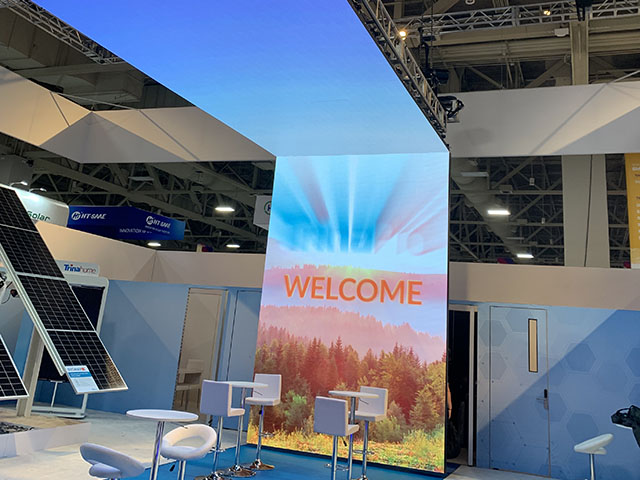
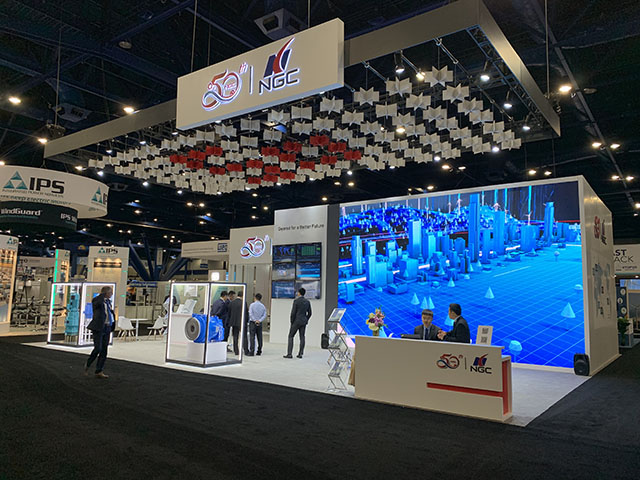
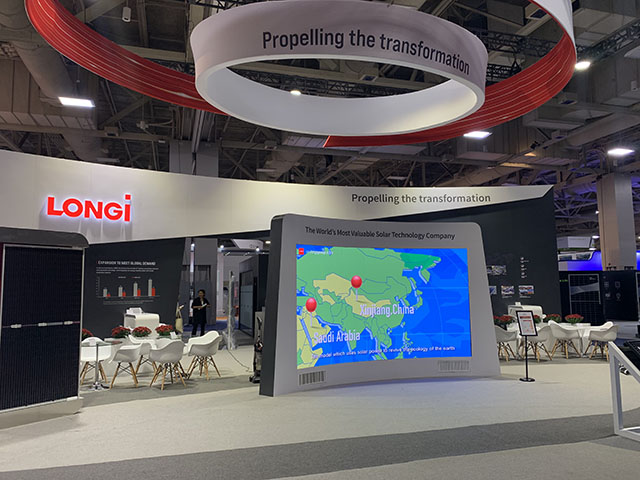
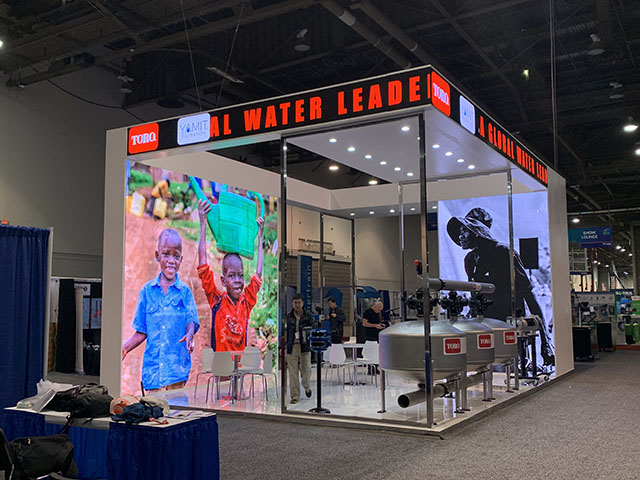
When the LED video wall is integrated into the booth design itself, whether as a structural back wall, a hanging element, or a wraparound feature, it doesn’t just show video. It becomes the visual foundation of the entire space. Your graphics, your messaging, your brand colors, and your content strategy all get designed around a single cohesive visual system.
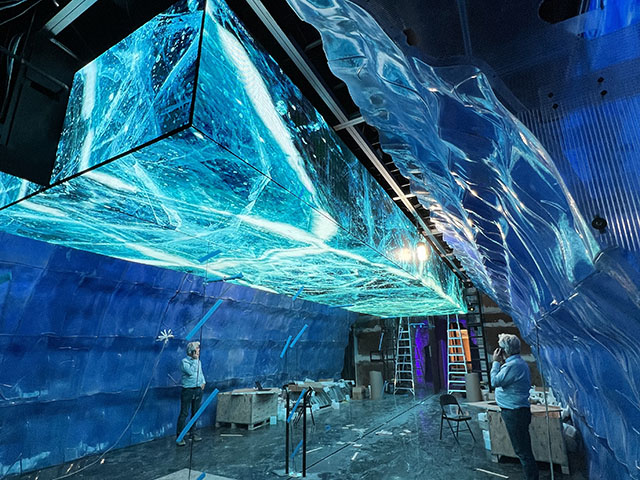
That kind of integration is something a projector can’t easily replicate. You can’t seamlessly build a projector into a custom exhibit structure the same way. There’s always a throw distance required, a screen surface needed, and a dark path between lens and surface that has to stay clear. LED panels mount flush, configure to custom dimensions, and can be shaped to fit almost any booth footprint.
At TrueBlue Exhibits, we design and build custom trade show booths with LED video wall elements as part of a fully integrated end-to-end process. We’re not just providing an AV rental that gets dropped off at your booth. We design the exhibit, integrate the display technology, handle booth installation and show services, and manage the project from concept through teardown. Most exhibit rental companies and most AV companies handle their side of the equation separately. We handle both.
That matters because when the booth design and the display technology aren’t coordinated, you get compromises. The screen’s too small for the wall. The mounting doesn’t fit the structure. The content doesn’t match the booth’s visual direction. We see it at shows constantly.
Not all LED walls are the same, and pixel pitch is the spec that matters most for trade show use.
Pixel pitch refers to the distance between the centers of adjacent LED clusters, measured in millimeters. A smaller pitch means more pixels per square foot, which means sharper resolution when viewers are standing close. For trade show booths where attendees are often within 5 to 10 feet of the display, a tighter pitch (like P1.5 or P1.9) typically produces better results. Larger pitches work fine for content viewed from farther away and can help reduce cost, but aren’t always the right call in a tight booth environment.
We carry P1.5 and P1.9 configurations specifically because they’re well-suited to the close-viewing demands of trade show floors. If you’re not sure which is right for your setup, our booth design team can walk through the options based on your booth size and content type.
We want to be straightforward here. Projectors aren’t obsolete.
If you’re exhibiting in a smaller footprint, you have a controlled lighting environment, your budget is limited, and your content is primarily slides or light video, a projector can be a reasonable solution. For breakout sessions inside a conference room adjacent to your booth, or for a small tabletop display in a dimmer venue, they’re workable.
But for standard trade show floors at major convention centers, in a competitive environment where every exhibitor is trying to draw foot traffic? In most cases, a projector isn’t going to give you the visual presence you need. The ambient light alone will undercut it.
For most exhibitors at most trade shows, LED walls are the stronger choice. The brightness advantage alone is hard to argue with in a venue you don’t control. Add the image quality difference, the reliability factor, and the integration potential, and the case gets even clearer.
The question worth asking isn’t just “LED or projector?” It’s “how does my display technology fit into my overall booth experience?” When those two things are designed together, the result is something a standalone AV rental can’t deliver.
Browse our LED video wall booth portfolio to see what integrated exhibit and display design actually looks like in practice.
If you’re planning your next trade show and want to understand what an integrated LED video wall booth looks like for your brand, we’d love to hear about your project. Contact TrueBlue Exhibits and let’s start with a free consultation. We’ll walk through your show schedule, your booth goals, and the display configuration that fits.
In most trade show environments, yes. Convention halls have high ambient light that causes projected images to appear washed out or hazy. LED walls produce their own light and maintain vivid, sharp images regardless of surrounding brightness. For exhibitors competing for attention on a busy show floor, LED walls generally deliver a stronger visual presence.
LED video wall rental costs vary based on panel size, pixel pitch, configuration, and the length of the event. The total cost also depends on whether services like installation, technical support, and project management are included. Generally speaking, turnkey LED wall rentals that include setup and support represent a higher upfront cost than projectors but often deliver better value when image quality and reliability are factored in.
Pixel pitch is the distance in millimeters between the centers of adjacent LED pixel clusters. A smaller pixel pitch means higher resolution when viewed up close. For trade show booths where attendees often stand within 5 to 15 feet of the display, tighter pitches like P1.5 or P1.9 produce sharper, clearer images. Larger pixel pitches can reduce cost and work well for content viewed from a greater distance.
A projector can work in certain trade show scenarios, particularly smaller booths in dimmer indoor environments with controlled lighting. However, most major convention centers have significant ambient light that challenges projector performance. For large-format booth displays in standard exhibition halls, projectors are generally at a disadvantage compared to LED video walls.
A standalone LED wall rental provides the display hardware. An integrated LED video wall booth means the display technology is designed into the exhibit structure itself, with graphics, content, and booth layout all coordinated around the display. The integrated approach typically produces a more cohesive visual result and avoids common mismatches between the display and the surrounding exhibit design.
LED panels are generally rated for around 50,000 to 100,000 hours of operational life, and their brightness doesn’t degrade in the same way projector lamps do. Projector lamps typically last a few thousand hours and gradually dim before failing. For exhibitors attending multiple shows per year, LED technology tends to be the more reliable and consistent option.
Not necessarily, but it helps significantly. LED walls can display standard video formats, but content designed for the specific aspect ratio and dimensions of your wall will look far better than content simply stretched to fit. If you’re using a non-standard aspect ratio or a custom-shaped display, custom content is strongly recommended to avoid distortion or letterboxing.
 We Do It Right, The First Time and Every Time
  3D Booth Rendering Always Go Win-Win Happy Everything Committed Customer Clockwork
