




Key Takeaways
Walk a trade show floor at the Las Vegas Convention Center during a major show and you’ll notice something almost immediately. Some booths get traffic. Others don’t. And it’s rarely about which company has the better product.
It’s about what gets seen first.
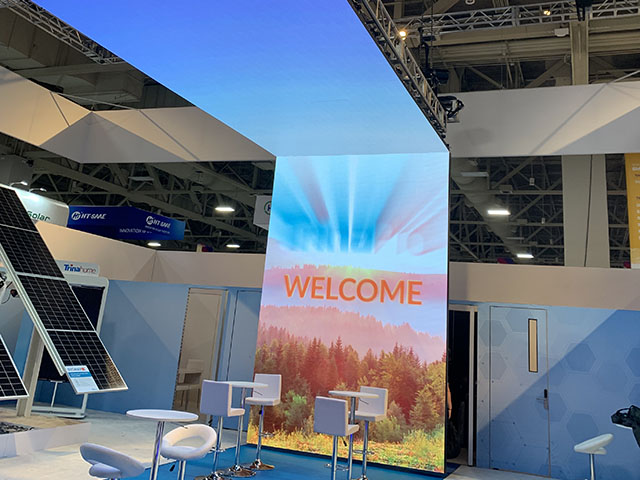
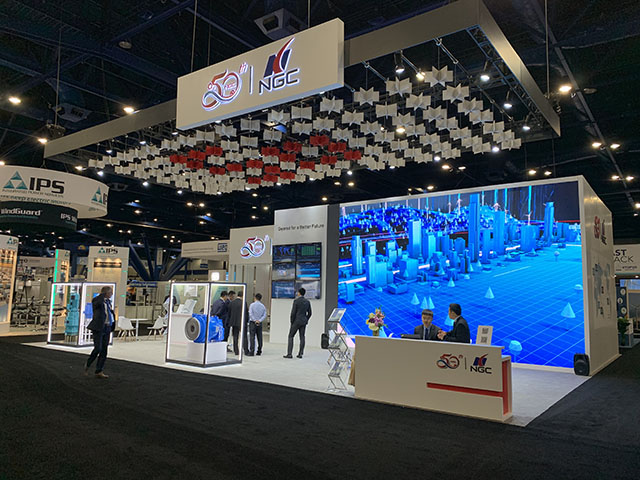
That’s the real job of an LED video wall at a trade show. Not decoration. Not novelty. It’s a traffic tool, and when it’s designed right and integrated into the booth, it changes how people move through an aisle.
Table of Contents
Think about the last trade show you walked as an attendee. You were probably doing what most people do: scanning the floor from a distance, deciding which booths were worth walking toward. Static banners, printed graphics, and backlit fabric displays all blend into each other after a while. They’re not wrong, but they’re quiet.
An LED video wall is not quiet. Motion draws the eye. Bright, high-contrast visuals are processed before a person consciously decides to look. That’s not a marketing opinion, it’s just how human attention works.
And in a crowded convention hall, being seen from 30 or 40 feet away is the difference between getting a visit and getting skipped. Research from CEIR consistently shows that 81% of trade show attendees have buying authority for the products and services exhibited. The people walking the aisles aren’t casual, they’re decision-makers. But they’re also moving fast and choosing selectively. If your booth isn’t arresting attention from a distance, you’re competing for the leftovers.
Here’s the specific mechanism worth understanding. When a passerby stops to watch something on a large display, even for five seconds, your team has an opening. That’s dwell time. And dwell time converts.
The content playing on the wall does the early work of your pitch. A well-produced product video, a case study, branded animation, or even a simple rotating graphic loop communicates what you do before anyone on your team says a word. By the time a visitor steps into the booth, they’ve already self-selected. They’re interested. That’s a very different conversation to start than cold-stopping someone in an aisle.
So when people ask whether LED video walls increase booth engagement, the honest answer is: they increase the quality of the engagement, not just the volume. Visitors who are drawn in by dynamic visual content tend to be more curious and more ready to talk. According to trade show data compiled by Trade Show Labs, 74% of trade show attendees say that engaging with exhibitors increases their likelihood of buying. The visual environment your booth creates directly shapes whether that engagement happens in the first place.
Many companies approach a trade show with two separate problems: “We need a booth” and “We need a video wall.” So they find an exhibit rental company, get a booth built, and then source an AV vendor to supply and hang the display. That sounds reasonable until you’re on the show floor and the screen dimensions don’t integrate with the exhibit structure the way anyone pictured, or the cabling runs aren’t where they need to be, or the content looks mismatched with the surrounding graphics.
This is actually a bigger issue than most pre-show planning documents address.
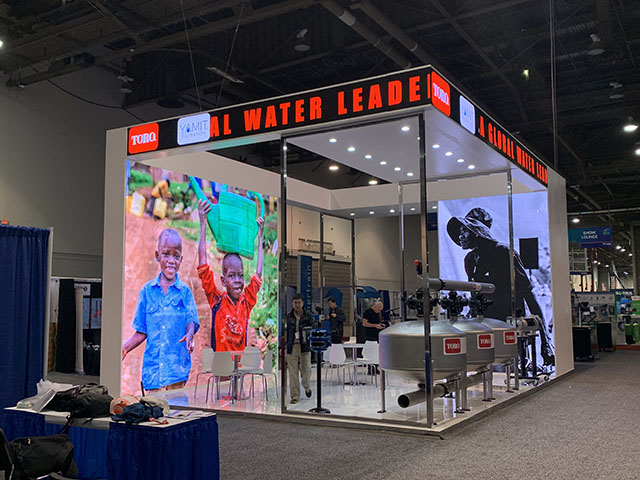
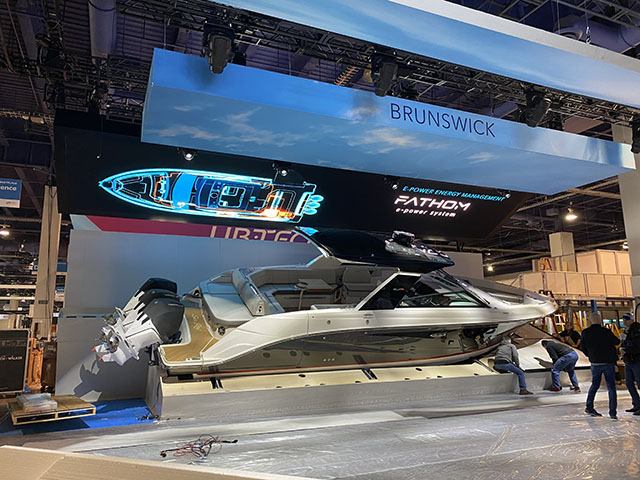
At TrueBlue Exhibits, we handle both sides. We design and build custom trade show booth rentals with the LED video wall designed as part of the booth, not bolted on afterward. The 3D booth rendering we provide to every client shows exactly what the completed booth will look like, video wall and all, before anything is fabricated. What you see in that rendering matches what shows up on the floor. That matters because the visual relationship between the display and the surrounding structure is what makes the whole thing look intentional rather than assembled.
This is where a lot of exhibitors get tripped up. Bigger isn’t always better, and higher resolution isn’t always necessary. The right choice depends on viewing distance.
Pixel pitch is the measurement of the gap between individual LED clusters on a panel, expressed in millimeters. A P1.5 display (1.5mm pixel pitch) is a fine-grain, high-resolution option best suited for viewers standing relatively close to the screen. A P3.9 panel is coarser and better suited to audiences viewing from farther away, where the human eye can’t distinguish the difference anyway.
For most trade show environments, especially a 20′ x 20′ or 20′ x 30′ island booth, a P1.9 display generally hits the right balance. Close enough for product detail, bright enough for busy convention lighting. For wider aisle placements where visitors are viewing from 15 to 20 feet away, you have more flexibility in pixel pitch without losing perceived image quality.
We offer both P1.5 LED video wall rental and P1.9 LED video wall rental options, and part of our consultation process is helping clients figure out which spec actually makes sense for their booth layout and content type, not just selling the premium panel for its own sake.
Some exhibitors still ask whether a projector is a reasonable alternative. In most cases, it isn’t, and the reasons are practical rather than just technical.
Projectors require controlled ambient light to produce a clear image. Convention halls don’t have that. The overhead lighting at a place like the Las Vegas Convention Center or McCormick Place is bright by design, and a projected image washes out under those conditions. An LED panel emits its own light from the surface of the display, which means it’s not fighting the room. You get consistent brightness and contrast regardless of what the ceiling is doing.
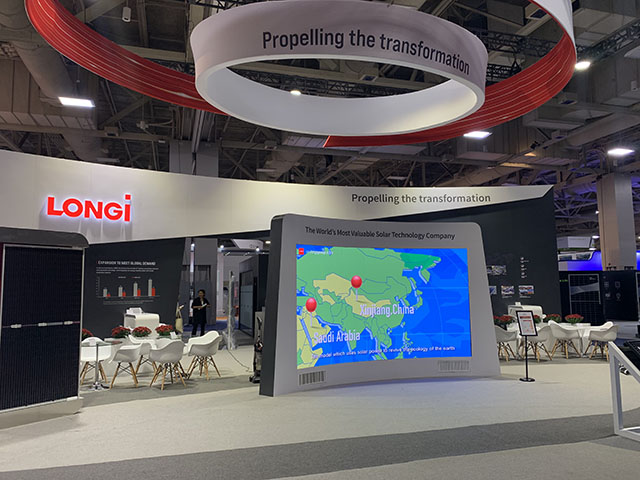
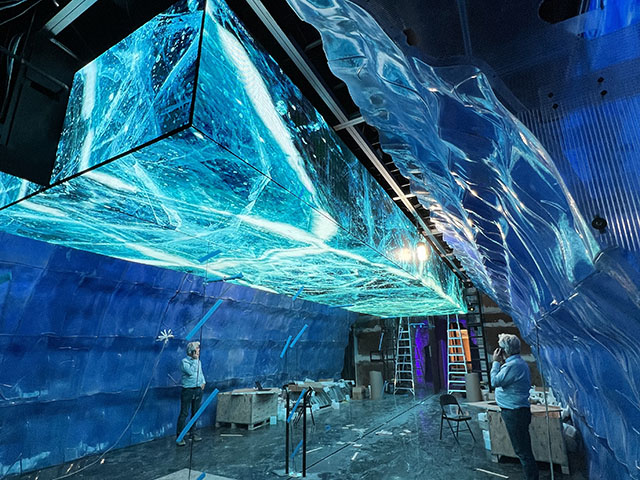
There’s also the flexibility factor. LED panels are modular. You can build them into almost any size or aspect ratio, tall and narrow, wide and horizontal, even curved configurations. A projector requires a flat surface, throw distance, and a clean line-of-sight. On a trade show floor with other exhibitors on all sides, that’s often not realistic.
This is probably the most underserved topic in most articles about video walls at trade shows.
The screen is just the delivery mechanism. What’s on it determines whether people stop or keep walking. A static logo on a giant LED wall is better than a banner, but not by as much as you’d think. The real engagement lift comes from motion: product demonstrations, timed messaging sequences, brand storytelling, or even simple animated graphics that catch the peripheral vision.
One thing worth planning before the show: make sure your content is sized to match your actual screen’s aspect ratio. A 16:9 video file displayed on a custom aspect ratio wall will either appear letterboxed with black bars, stretched to fit, or cropped. None of those look intentional. If you’re going with a custom wall configuration, custom content is worth the investment.
We’re based in Las Vegas, and a significant portion of our work happens at the major convention centers here. But our Las Vegas LED video wall rental operation is just one part of how we work. We have satellite stock in San Francisco, Chicago, and Orlando, with over 15,000 LED panels available to deploy. For exhibitors doing shows outside Nevada, that matters. It means we’re not air-freighting panels cross-country for every job, which keeps lead times manageable and costs reasonable.
For clients who exhibit at 20′ x 20′ and larger booths across multiple cities, we handle the full logistics chain from exhibit transportation to installation and dismantle. Our clients are focused on their booth staff and their prospects. We take care of the rest.
Whether you’re exhibiting in Las Vegas, Chicago, Orlando, or anywhere in the lower 48, our full LED video wall services travel with us.
If you’re considering adding an LED video wall to your next trade show exhibit, or if you’ve been doing it and the results haven’t matched expectations, let’s talk through it. The difference between a well-integrated video wall booth and a screen dropped into an existing booth design is visible from 40 feet away.
Contact us and tell us about your next show. We’ll start with a free design consultation and go from there.
LED video walls produce high-brightness, motion-based content that’s visible from across a crowded convention floor. The movement draws attention from attendees before they’ve consciously decided which direction to walk. This increases stop rates at the booth and gives your team a warm, pre-engaged audience rather than cold passersby.
For most exhibitors who don’t show more than a handful of times per year, renting is generally the smarter financial decision. Renting eliminates the cost of storage, maintenance, panel repair, and transportation logistics. It also gives you flexibility to adjust screen size and configuration from show to show based on your booth space.
It depends on your booth size and where attendees will be standing when they view the display. For a 20′ x 20′ booth where visitors come within 8 to 12 feet of the screen, a P1.5 or P1.9 panel typically delivers the clearest image. For larger booths with more viewing distance, a P2.9 or P3.9 can work well at a lower cost per square foot.
Most exhibit rental companies source video walls separately through AV vendors, which creates coordination challenges. Fewer companies design and integrate the display as part of the booth structure from the beginning. TrueBlue Exhibits handles both, which means the LED wall is factored into the 3D design, structural planning, and installation from day one.
Screen size should be determined by viewing distance, available booth real estate, venue weight restrictions, and what your content is meant to communicate. A larger screen isn’t always more effective. For a 20′ x 20′ booth, a wall in the range of 8 to 12 feet wide is a common starting point, but the right answer depends on your specific setup.
Motion-based content consistently outperforms static images. Product demonstration videos, branded animation, timed messaging loops, and case study visuals tend to draw and hold attention best. Your content should also be sized to match your screen’s actual aspect ratio to avoid letterboxing, stretching, or cropping artifacts.
Yes. TrueBlue Exhibits maintains LED panel inventory in Las Vegas, San Francisco, Chicago, and Orlando, with deployment capability across all 48 contiguous states. We handle transportation, setup, and on-site support regardless of the show location.
 We Do It Right, The First Time and Every Time
 3D Booth Rendering
 Always Go
 Win-Win Happy
 Everything
  Committed
  Customer
 Clockwork