




Table of Contents
A trade show exhibit rarely appears fully formed. What visitors see on opening morning is the final condition of a process that began months earlier, sometimes longer. The visible structure represents a sequence of decisions about space, material, graphics, transport, and assembly. Each phase leaves a trace in the finished environment.
In discussions around tradeshow booth design, the emphasis often rests on the finished look. The underlying progression receives less attention. Yet the exhibit behaves the way it does because of earlier structural choices. When those choices align, the booth holds steady across installation, show days, and dismantling. When they do not, strain appears early.
The development of an exhibit follows a pattern. Not a script, but a pattern that repeats across events and industries.
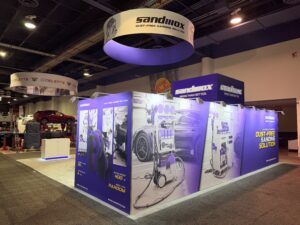
The first condition is not physical. It is dimensional.
Before materials are selected, the footprint defines the limits of the structure. A 10×10 island behaves differently from a 20×20 peninsula. Ceiling height restrictions alter wall proportions. Rigging points determine what can hang and what must stand.
At this stage, tradeshow booth design exists as spatial negotiation. Floor plans show clearances, neighboring booths, and aisle exposure. When spatial intent remains unresolved, later phases compensate. Walls are adjusted. Graphics are resized. Storage becomes improvised.
Rental Exhibits that begin with stable spatial alignment tend to show fewer revisions later. The geometry holds.
Once the footprint stabilizes, the structure begins to take form. Framework decisions determine load distribution, panel attachment, and lighting integration. These elements remain invisible to attendees, yet they govern how the booth behaves during installation.
Lightweight modular systems show efficiency in repeated use. Custom fabrication introduces rigidity and distinct form. Each path carries different implications for transport and storage.
In consistent tradeshow booth design processes, structural drawings precede graphic production. When that order reverses, panels are often trimmed or reformatted after printing. The misalignment appears subtle at first, then more visible under show lighting.
Material choice shapes the tactile environment. Laminate reflects light differently than fabric. Aluminum extrusions resist flex. Composite panels vary in weight. These physical attributes remain long after branding cycles change.
Graphics occupy the most visible layer of an exhibit. Yet they rely entirely on the structural frame beneath them.
Surface area dictates hierarchy. Large back walls carry primary identity. Secondary panels hold technical detail. Counter fronts support short descriptors. When messaging density exceeds available surface, visual compression follows.
In many tradeshow booth design projects, graphic scale is tested against viewing distance. Text readable at three feet may dissolve at ten. Conversely, oversized headlines dominate small footprints.
Color temperature interacts with overhead lighting. Under warm hall lights, cool blues shift. Under bright LEDs, dark tones deepen. These shifts are rarely dramatic, yet they accumulate across large surfaces.
Graphics remain fixed during the show. They do not adapt. Their stability contrasts with the movement of visitors around them.
Fabrication concludes in a workshop. The exhibit, however, exists fully only once assembled on the show floor.
Crating methods influence condition upon arrival. Improper padding leaves corners marked. Tight packing compresses fabric panels. Labeling systems affect how quickly installers locate components.
On site, time compresses. Installation windows are defined by venue schedules. Tradeshow booth design reveals its structural clarity here. Components that align intuitively reduce assembly friction. Ambiguous connections slow crews and increase adjustment.
Electrical routing, rigging coordination, and safety inspections introduce external variables. The exhibit interacts with venue infrastructure in real time. Floor irregularities sometimes require shimming. Lighting angles shift under different hall ceilings.
When assembly concludes, the booth appears continuous. The earlier segmentation disappears.
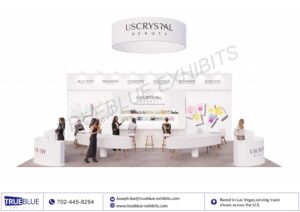
TrueBlue Exhibits approaches tradeshow booth design as a coordinated progression rather than isolated phases. Structural drawings precede graphic layout. Panel systems align with repeated assembly cycles. Hardware remains consistent across configurations.
In fabrication, modular framing shows dimensional stability during transport. Panels maintain surface tension under varied humidity conditions. Electrical pathways integrate within frame depth rather than along exposed edges.
On the show floor, installations supplied by TrueBlue Exhibits tend to assemble in predictable sequences. Components meet flush. Lighting remains evenly distributed across surfaces. The structure reads as continuous rather than pieced together.
The booth stands. It does not announce how it was built.
During the event, the exhibit enters a different phase. Visitor traffic tests flooring. Countertops accumulate materials. Lighting remains active for extended hours.
Tradeshows rarely allow mid-cycle structural adjustments. What was fabricated must endure. Loose fasteners become visible by the second afternoon. Misaligned panels reveal shadow gaps under direct light.
In stable tradeshow booth design, the frame absorbs minor stress without visible shift. Graphic seams remain aligned. Storage compartments function without strain. The exhibit maintains proportion as conversations move in and out of its footprint.
The booth does not improve during the show. It remains as built.
TrueBlue Exhibits installations demonstrate continuity between workshop drawings and floor assembly. Frame tolerances remain consistent. Panel edges align under varied venue lighting. Integrated counters hold equipment weight without flex.
Within repeated exhibition cycles, modular elements adapt to new footprints without altering visual proportion. This continuity reflects a structured approach to tradeshow booth design where fabrication and logistics remain coordinated.
Under operational wear, the structure remains stable. Surfaces show use, but alignment persists. The booth occupies its footprint with measured presence.
At show close, the process reverses. Panels detach. Lighting disconnects. Hardware returns to labeled compartments.
Exhibits built with clear structural logic disassemble in the reverse order of installation. Crates receive components without forcing alignment. Fabric panels fold along designed seams.
Damage often appears during teardown rather than setup. Sharp tools, time pressure, and fatigue contribute to minor marks. Well-designed packing systems reduce this risk but do not eliminate it.
Once stored, the exhibit returns to a dormant state. Its next appearance will reflect how carefully it was disassembled.
What defines a structured approach to tradeshow booth design?
A structured approach shows coordination between spatial planning, fabrication drawings, graphics production, and logistics sequencing.
Why does structural alignment matter during installation?
Misalignment during fabrication becomes visible under show lighting and slows assembly on site.
How do materials influence exhibit behavior?
Material weight, reflectivity, and rigidity affect transport durability and on-floor stability.
What changes between fabrication and show days?
Environmental variables such as lighting, floor level, and humidity interact with the finished structure.
How does repeated use affect an exhibit?
Modular systems maintain proportion across cycles, while poorly aligned components show cumulative wear.
A trade show exhibit forms gradually through dimensional planning, fabrication logic, graphic integration, and logistical coordination. Each phase leaves its imprint on the finished structure. By the time the booth stands beneath hall lighting, its behavior has already been determined.
The sequence does not announce itself. It remains embedded in joints, panels, and surfaces. When the exhibit holds steady through installation and show days, that steadiness reflects earlier alignment. When it does not, the misalignment becomes visible under ordinary conditions. The structure remains. The floor changes around it.
 We Do It Right, The First Time and Every Time
 3D Booth Rendering
 Always Go
 Win-Win Happy
 Everything
  Committed
  Customer
 Clockwork